
Key Takeaways: At a Glance
- New 2025 Federal Changes: The lowest federal tax bracket rate has effectively dropped to 14.5%.
- Basic Personal Amount: You can earn up to $16,129 federally before paying any income tax.
- Inflation Adjustment: Brackets have shifted upward, meaning you might pay less tax on the same salary compared to last year.
- Marginal ≠ Average: You only pay the higher rate on the portion of income that exceeds the threshold—not your entire salary.
- CPP Ceilings: The new YMPE is $71,300, with a second earnings ceiling (YAMPE) of $81,200.
Understanding Canadian tax brackets for 2025 is the single most effective way to optimize your financial planning. Whether you are an employee, a freelancer, or a business owner, knowing where you sit on the scale determines how much of your hard-earned money you keep.
Many Canadians fear “jumping” into a higher tax bracket, believing they will take home less money overall. This is a myth.
In this guide, we will break down the exact 2025 federal and provincial rates, explain the “effective rate” nuance that many calculators miss, and provide actionable strategies to lower your taxable income.
2025 Federal Tax Brackets and Rates
The federal government taxes the income of all Canadian residents. For the 2025 tax year, there is a significant change to note: the effective tax rate for the first bracket.
Because the government reduced the lowest bracket rate from 15% to 14% starting July 1, 2025, the blended rate for the full 2025 tax year is 14.5%.
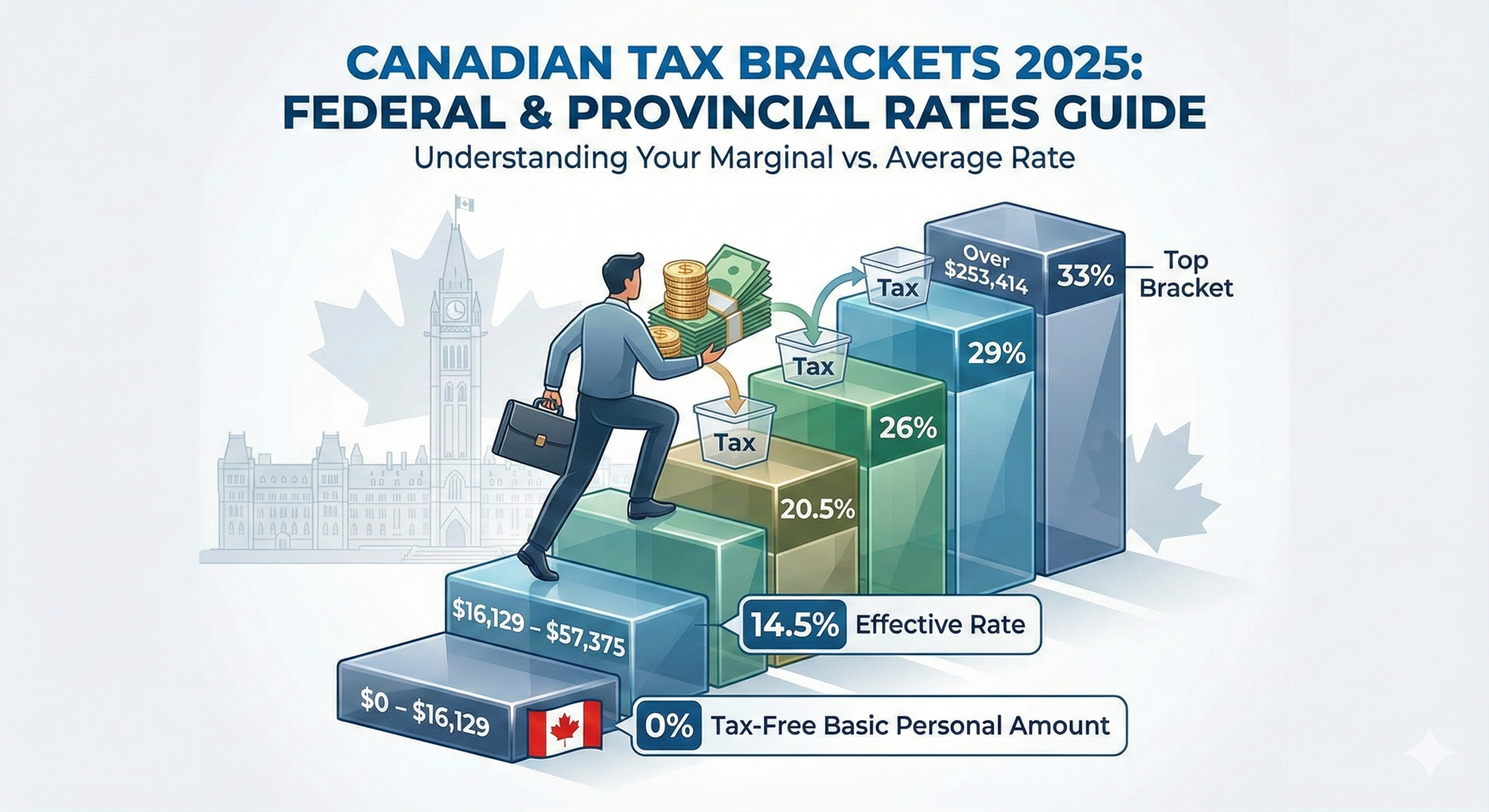
Federal Income Tax Rates (2025)
| Taxable Income Range | Tax Rate | Notes |
|---|---|---|
| $0 – $16,129 | 0% | Basic Personal Amount (Tax-Free) |
| $16,129 – $57,375 | 14.5% | Effective rate (blended 15% & 14%) |
| $57,375 – $114,750 | 20.5% | |
| $114,750 – $177,882 | 26.0% | |
| $177,882 – $253,414 | 29.0% | |
| Over $253,414 | 33.0% | Top Federal Bracket |
Pro Tip: The Basic Personal Amount (BPA) of $16,129 means the first ~$16k you earn is effectively tax-free for federal purposes. However, this amount begins to decrease once your net income exceeds $177,882.
Provincial Tax Brackets 2025
You don’t just pay federal tax; you also pay provincial tax based on where you lived on December 31, 2025.
Provincial rates vary wildly. For example, a high earner in Nova Scotia pays significantly more provincial tax than a high earner in Alberta or BC.
British Columbia (BC)
BC offers some of the lowest rates for lower-income earners but ramps up for high-net-worth individuals.
- 5.06% on the first $49,279
- 7.70% on the next $49,281
- 10.50% on the next $14,598
- 12.29% on the next $24,249
- 14.70% on the next $48,899
- 16.80% on the next $73,523
- 20.50% on amount over $259,829
Alberta
Alberta continues to maintain a competitive advantage, though it introduced a new bracket structure effective Jan 1, 2025.
- 8.00% on the first $60,000 (New for 2025)
- 10.00% on income between $60,000 and $148,269
- 12.00% on the next $29,653
- 13.00% on the next $59,308
- 14.00% on the next $118,615
- 15.00% on amount over $355,845
Ontario
Ontario has a complex surtax system that applies on top of these base rates, which can increase your effective tax payable significantly.
- 5.05% on the first $51,446
- 9.15% on the next $51,448
- 11.16% on the next $47,106
- 12.16% on the next $70,000
- 13.16% on amount over $220,000
(Note: Ontario also applies a “Health Premium” based on income, which is technically a tax.)
Marginal vs. Average Tax Rate: The Confusion Killer
This is the most misunderstood concept in Canadian finance.
- Marginal Tax Rate: The tax you pay on the next dollar you earn.
- Average (Effective) Tax Rate: The total tax you paid divided by your total income.
Example:
Imagine you live in Ontario and earn $60,000.
You are in the “20.5% Federal” bracket.
- Does the government take 20.5% of your $60,000? No.
- They take 14.5% on the first $57,375.
- They take 20.5% only on the remaining $2,625.
Your Marginal Rate is high (what you pay on a bonus), but your Average Rate is much lower (what you actually feel).
Why this matters: Never turn down a raise because you think it will put you in a higher bracket. You will always take home more money after a raise, regardless of the tax bracket jump.
5 Actionable Strategies to Lower Your Tax Bracket
You cannot change the tax laws, but you can change your “Taxable Income.” Here is how to use the skyscraper method to build your wealth by lowering your tax obligations.
1. Maximize RRSP Contributions
This is the “gold standard” for bracket management. Every dollar you contribute to a Registered Retirement Savings Plan (RRSP) is deducted directly from your taxable income.
- Scenario: If you earn $120,000 (26% bracket) and contribute $6,000 to your RRSP, your taxable income drops to $114,000. You essentially “refund” yourself the tax you would have paid on that $6,000 at your highest marginal rate.
2. Deduct Union and Professional Dues
Did you pay for professional certification (CPA, P.Eng, RN) or union dues? These are “Line 21200” deductions. They reduce your taxable income dollar-for-dollar.
3. Spousal RRSP Loans
If you are in a high tax bracket and your spouse is in a lower one, contribute to a Spousal RRSP. You get the tax deduction now (at your high rate), and when the money is withdrawn in retirement, it is taxed in your spouse’s hands (at their lower rate).
4. Claim Moving Expenses
Did you move at least 40km closer to a new work location or school in 2025? You can deduct:
- Transportation and storage costs.
- Travel expenses.
- Costs of cancelling a lease or selling your old home.
5. Carrying Charges & Interest Expenses
If you borrowed money to invest (in non-registered accounts) to earn investment income, the interest you pay on that loan is tax-deductible. This is a powerful tool for sophisticated investors.
Frequently Asked Questions (FAQ)
1. What is the tax bracket for 2025 in Canada?
2. How much tax do I pay on $100,000 in Canada?
- Federal Tax: approx. $14,500
- Provincial Tax: varies (e.g., ~$6,000 in BC vs ~$9,000 in Ontario)
- CPP/EI: approx. $4,000 – $5,000
You would take home roughly $72,000 to $76,000 depending on your province.
3. What is the difference between marginal and average tax rates?
4. What is the Basic Personal Amount for 2025?
5. Does working overtime push me into a higher tax bracket?
Next Steps: Optimize Your 2025 Strategy
Now that you are armed with the 2025 tax bracket data, do not just file and forget.
Need further guidance? Talk to a financial professional to ensure you are maximizing every deduction and credit available to you.